
Releases Explained by the Courthouse
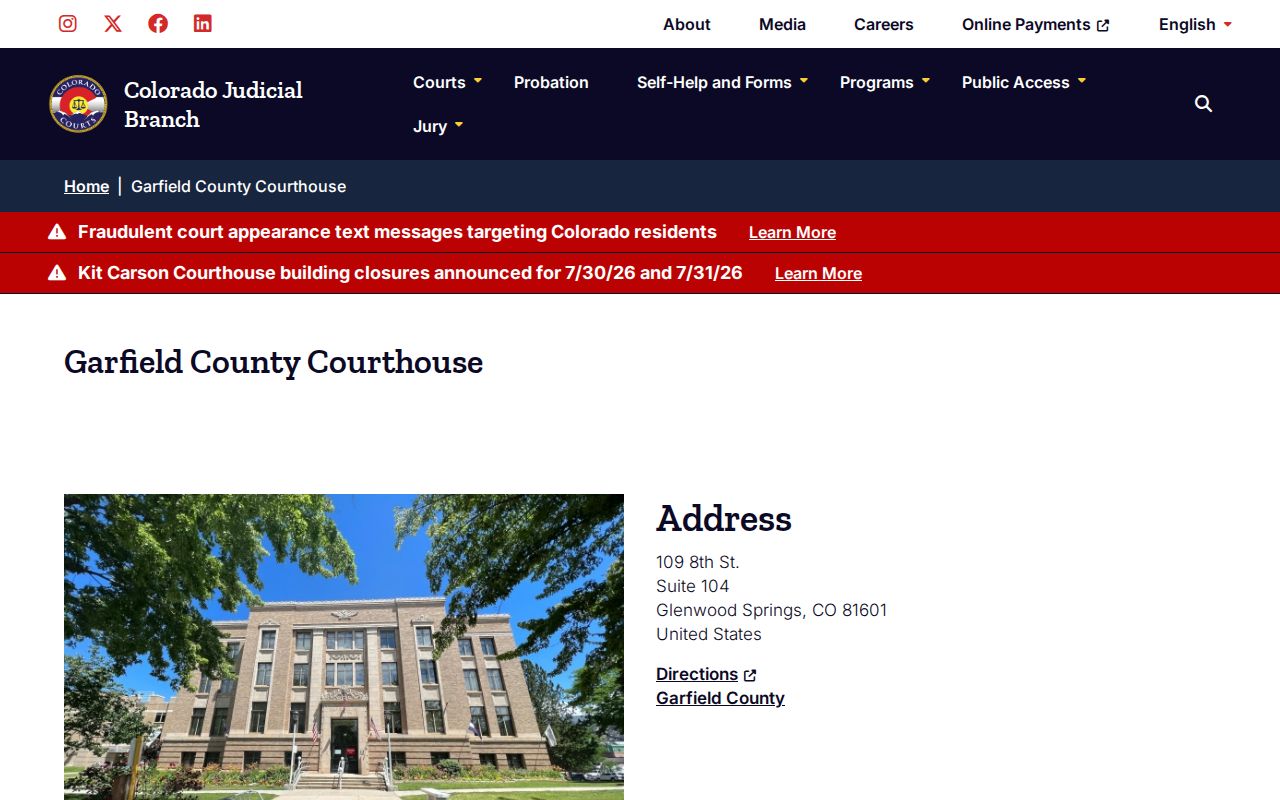
The Garfield County Courthouse at 109 8th Street, Suite 104, Glenwood Springs is a state trial court location for the Colorado Judicial Branch. It is next to the county jail at 107 8th Street, which makes the jail and court records closely connected but not interchangeable. The jail record tells whether a person was booked, held, and released from local custody. The court record explains the legal authority behind that custody event.
A person may leave the Garfield County Jail because the court reduced bond, accepted bond, granted personal recognizance release, dismissed charges, recalled a warrant, imposed probation, sentenced the person to time served, entered a mittimus for jail or DOC, or modified a sentence. Those events are not fully visible in the sheriff recent-release block. Once the person disappears from the public jail report, the court docket is often the most durable public trail.
How to Confirm a Court-Ordered Release
Start with the custody system, then use the court record to explain it. If the person was just released from Garfield County Jail, check the sheriff current-inmates PDF and the "Recent Releases" block first. If the release reason is unclear, search the Colorado Judicial Branch docket for the Garfield County case. The docket search requires a date plus at least one other filter, and Garfield County Courthouse appears as a court-location filter.
- Capture the jail PDF timestamp and recent-release line if the person appears there.
- Search the Colorado Judicial Branch docket using the person's name, case number, or date and Garfield County court filter.
- Look for bond orders, PR release, dismissal, plea, sentence, probation order, warrant recall, mittimus, or compliance-review entries.
- If the docket is not enough, request public court records from the courthouse using the court's record-search process.
- Compare the court order with the sheriff booking or release record when the exact release reason matters.
- Use CDOC, VINE, BOP, ICE, or USMS only when the court record points to those systems.
Court disposition is not the same as jail release. A person can be released before the case is finished, especially after bond. A person can also remain in custody after disposition because of a jail sentence, DOC sentence, parole hold, federal hold, immigration transfer, or another case. The court record gives context; the custody record says where the person was held.
Garfield County Courthouse Records and Contact
The Colorado Judicial Branch lists the Garfield County Courthouse at 109 8th Street, Suite 104, Glenwood Springs, CO 81601. The research gives phone 970-928-3065, email GCGWSCourt@judicial.state.co.us, and hours Monday through Friday from 8:00 a.m. to 4:50 p.m. Court staff can explain record-search procedures and public access options, but they do not replace legal advice or the sheriff's custody confirmation role.
Garfield County Courthouse
109 8th Street, Suite 104
Glenwood Springs, CO 81601
Phone: 970-928-3065
Email: GCGWSCourt@judicial.state.co.us
Hours: Monday-Friday 8:00 a.m.-4:50 p.m.
Useful court record terms
Docket, disposition, mittimus, bond order, PR bond, sentence, probation order, warrant recall, case sealing status, and public access terminal search.
When requesting records, provide a case number if you have it. If not, provide the person's name, approximate hearing date, charge or incident date if known, and the reason you are trying to match the court record to a release. If the person was booked in jail, also compare the sheriff booking number and release date if available.
About Garfield County Courthouse
This page treats the courthouse as a release-confirmation facility because courts create the orders that often end custody. It is not a jail, prison, or detention center. It does not publish a recent-release feed. Its role is to maintain case records that explain why a person was released, transferred, sentenced, placed on probation, or ordered to another custody setting.
| Court document | How it can explain release |
|---|---|
| Bond order | Shows release conditions and next appearance after jail custody ends |
| Mittimus | Shows sentence, custody destination, and presentence confinement credit |
| Disposition | Shows plea, dismissal, sentence, or final case outcome if public |
| Probation order | Shows supervision after release from physical custody |
Sentence Credit and Time Served
Colorado presentence confinement credit is a court issue before it becomes a custody calculation. C.R.S. 18-1.3-405 provides that confinement before sentence is credited against the sentence, and the sentencing court makes a finding to include in the mittimus. If someone says they were released time served, the release explanation often requires both the court order and the jail record.
For a county jail sentence, the sheriff applies local custody and deduction rules. C.R.S. 17-26-109 addresses county-jail deduction recordkeeping. For a DOC sentence, CDOC handles state sentence computation after the mittimus and court credit are entered. The courthouse record is the bridge between those systems, especially when the person moves from Garfield County Jail to CDOC or Rifle Correctional Center.
Probation Orders After Release
A release from the jail can lead to probation rather than prison or full discharge. Garfield County probation is handled through the Colorado Judicial Branch. The Glenwood Springs Probation Department is located at 109 8th Street, Suite 400, and the Rifle Probation Department is at 200 East 18th Street, Suite 105. A docket may show the probation sentence, while probation records and office contacts handle supervision details that are public or releasable.
Probation is not parole. Parole follows a prison sentence and is handled through CDOC and the State Board of Parole. If the court docket shows a DOC sentence or parole violation context, use CDOC and parole records. If it shows probation, use the court and probation route. Keeping these separate prevents a common Garfield County error: using a state prison search for someone released from jail directly onto probation.
When a Court Record Is Limited
Not every case detail is visible online. Sealing, juvenile restrictions, expungement rules, nonpublic filings, system lag, and agency discretion can limit what a public search returns. Colorado Judicial Branch form JDF 611 addresses sealing criminal conviction records in a single case, and state resources explain that eligibility and waiting periods vary. Absence from a public docket should not be treated as proof that no release or case exists.
If a jail release appears in the sheriff PDF but no obvious public docket is found, verify spelling, date, court location, and whether the matter was handled in Rifle, another county, municipal court, federal court, juvenile court, or a sealed/restricted file. Then contact the proper court or custodian for releasable records.