
Parole vs Probation in Garfield County
A Garfield County release can point to probation, parole, both in sequence, or neither. Probation is a court sentence or condition supervised through the Colorado Judicial Branch. Parole is post-prison supervision through the Colorado Department of Corrections and the Colorado State Board of Parole. That distinction matters because a person released from the Garfield County Detention Facility may have a probation order without ever entering CDOC custody, while a person released from Rifle Correctional Center should be checked through CDOC and parole records rather than the county jail PDF.
| Supervision type | What controls it | Where to verify |
|---|---|---|
| Probation | A Garfield County court order, sentence, deferred judgment, or violation disposition. | Colorado Judicial Branch docket records, Garfield County Courthouse, and the Glenwood Springs or Rifle probation office. |
| Parole | Release from a Colorado prison sentence to CDOC Adult Parole after parole-board action or mandatory-release rules. | CDOC Offender Search, the Colorado State Board of Parole calendar, Adult Parole, and court records for the original sentence. |
| Community corrections or work release | A structured local placement through Garfield County Criminal Justice Services or a DOC transition path. | Sentencing court records, Criminal Justice Services in Rifle, CDOC if the person is a transition client, and probation or parole if supervision is active. |
How to Verify Garfield County Supervision
To answer whether a released Garfield County person is on parole or probation, start with the custody source and the court case. The jail roster can show a recent release, but it does not identify every supervision condition. The court docket and sentence explain probation, bond conditions, warrant recalls, mittimus entries, and violation outcomes. CDOC records explain prison release, parole eligibility, parole status, and state supervision.
- Check the Garfield County Sheriff's current-inmates page and PDF if the release was recent. The PDF's top "Recent Releases" block is the county-jail clue, while the current custody list can show charges, booking number, and a bond or release-date column for people still listed.
- Search the Colorado Judicial Branch docket for the Garfield County Courthouse or Garfield County Associate Court - Rifle. Look for probation orders, sentencing entries, warrant recalls, bond orders, mittimus records, and compliance or revocation settings.
- If the person was sentenced to CDOC, search the CDOC Offender Search by DOC number or name. A prison release from Rifle Correctional Center or another Colorado prison belongs in CDOC, not the county jail roster.
- For parole timing, review the CDOC Parole Board calendar. Treat a hearing date as a scheduling record, not proof that release was granted.
- Use Colorado VINE at VINELink or (888) 263-8463 for custody-change notifications while the person is in a participating custody system.
- For formal historical proof, request the booking sheet, release information, or court record from the agency that maintains it. Garfield Sheriff's Records Division handles jail records; the court handles court orders and dispositions; CDOC handles prison and parole records.
Garfield County Supervising Offices
Garfield County probation has two local Judicial Branch office locations tied to the county's court geography. Parole is state supervision through CDOC Adult Parole, but Garfield County Criminal Justice Services also documents services for Division of Parole at its Rifle corrections location. Use the office that matches the case type and the court or CDOC record.
Glenwood Springs Probation
109 8th Street, Suite 400
Glenwood Springs, CO 81601
(970) 928-2999
Fax: (970) 928-8539
Monday-Friday, 8:00 a.m.-5:00 p.m.
Rifle Probation
200 East 18th Street, Suite 105
Rifle, CO 81650
Use the Garfield County probation page and court record to confirm the assigned office.
Criminal Justice Services
0244 County Road 333A
Rifle, CO 81650
970-625-0334
Community corrections, work release, and local Division of Parole service context.
The Glenwood Springs probation office is in the same courthouse block as the jail and trial court, while the Rifle probation office aligns with the Rifle Associate Court location. That local split is useful when a person was released from the jail after a Rifle case or when a sentence directs reporting in western Garfield County.
Conditions, Violations, and Absconders
Supervision conditions are case-specific. Probation conditions come from the sentencing court and probation department. Parole conditions come from CDOC and the parole process. A violation can lead to a new court setting, a warrant, a jail booking, a parole revocation hearing, or modified conditions. Garfield's current-inmates PDF may show a current jail inmate with a parole-violation charge or description, but that means the person is back in jail on a parole-related hold or allegation. It is not proof that a released parolee is still at liberty.
No official Garfield County-specific public parole absconder list was identified in the reviewed sources. The safer verification path is to check CDOC Offender Search for parole status, search the court docket for new warrants or cases, and contact the supervising agency or law enforcement when there is a safety or legal need. Colorado VINE can help with custody-change alerts while a person is held in a participating jail or prison, but VINE is not a complete historical supervision archive.
How Garfield County Supervision Ends
Probation usually ends by court action, expiration of the ordered term, termination, revocation, or another disposition entered in the case. Parole ends through CDOC discharge, revocation, sentence completion, or other state action. The public trail can be split: a jail release may appear in the sheriff PDF, a probation end point may appear in the court case, and a parole or discharge status may appear in CDOC records.
Colorado public-records rules also affect what can be seen after supervision. Jail records, arrest photos, booking sheets, and release records are criminal justice records under the Colorado Criminal Justice Records Act, while court sealing can limit public lookup in some cases. For a release-centered search, use the Garfield County released inmates path first, then narrow the request to the record holder: Garfield Sheriff's Records Division for jail release documents, Colorado Judicial Branch for probation and court records, and CDOC for prison or parole records.
Colorado Parole Hearings for Garfield Cases
The Colorado State Board of Parole calendar is relevant when a Garfield County conviction led to a CDOC sentence or when a person at Rifle Correctional Center is approaching parole review. The CDOC calendar displays monthly hearing schedules and states that future months become available after scheduling is set. It also warns that hearings are subject to change and that DOC modifications are available the following business day.
Public attendance requires advance arrangements. For application or rescission hearings, CDOC directs inquiries to the offender's case manager. For revocation hearings, the contact path can be the jail where the offender is located, which matters if a parolee is being held at the Garfield County Detention Facility on a violation. Possible outcomes include grant, denial, deferral, continuation, rescission, revocation, or continued parole with changed conditions. A scheduled hearing is not the same as a granted release, and a granted release is not always the same moment as physical release.
The parole eligibility rules come from Colorado Title 17 and depend on the offense date, conviction offense, sentence, credits, and special statutory categories. Listed violent offenses committed on or after January 1, 2025 can require 85 percent service before parole eligibility, while older listed violent-offense categories and other offenses can follow different rules. Avoid treating parole eligibility as an automatic release date.
Rifle Community Corrections Context
Garfield County's community corrections and work-release programs add a local layer between jail custody and full community supervision. The county identifies a residential component outside Rifle near the Garfield County Airport and says community corrections beds and work-release beds are available there. The work-release agreement describes selected clients serving jail time while leaving the facility for work up to 12 hours a day, five to six days a week.
That means not every person outside a jail cell has completed a sentence or supervision term. A work-release participant may still be serving jail time. A community corrections client may be serving a direct sentence or transitioning from DOC. Confirm the status through the sentencing court, Garfield County Criminal Justice Services, CDOC if it is a transition placement, and probation or parole if active supervision is shown.
Correcting Release Identity Details
When supervision records and jail records do not align, gather the underlying documents before assuming the public display is wrong. Garfield's records request form lets a requestor ask for a Booking Sheet and Booking photo, and asks for details such as GCSO report number, incident date, named persons, dates of birth, and documents requested. A precise request reduces mismatches for common names and helps separate a county-jail release from a CDOC parole record.
If the issue is a court order, probation status, sentence credit, or warrant recall, the court record is the better starting point. If the issue is jail custody, booking, release date, or release reason if releasable, the Garfield Sheriff's Records Division is the better starting point. If the issue is parole status after a state sentence, CDOC is the record holder.
Local Source View
The Colorado Judicial Branch probation page is the source for Garfield County's probation office locations. It helps separate probation reporting after a court sentence from parole reporting after a DOC release.
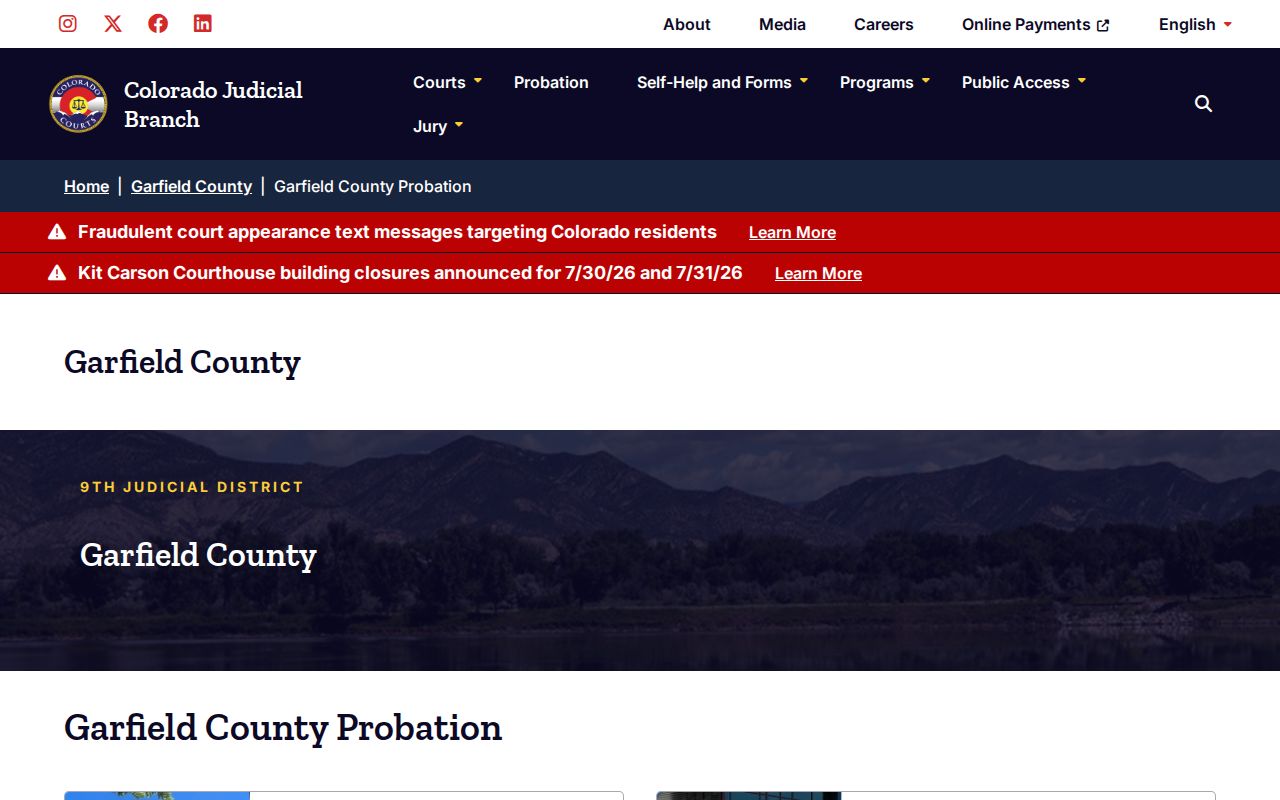
Use this kind of local office source only after identifying whether the person was released to probation, parole, community corrections, work release, or no supervision. The release label controls which agency can confirm the record.