
Projected vs Actual Release Date
A projected release date is a calculated or scheduled date based on the current record. It can move before the actual release happens. At the Garfield County Jail, the PDF can show a "Release Date" in the same column as "Bond Amount" for a current inmate. That is a local jail roster value. At CDOC, public fields can include parole eligibility date, next parole hearing, estimated mandatory release date, and sometimes projected-release wording depending on the offender detail page.
How to Find a Garfield County Projected Release Date
Start with custody type. The wrong system can produce a convincing but irrelevant result, especially in Garfield County because the county has both the jail in Glenwood Springs and Rifle Correctional Center, a CDOC prison, within the county.
- If the person is in Garfield County Jail, open the sheriff current-inmates PDF and read the timestamp plus the "Bond Amount or Release Date" column.
- If the person is pretrial, treat bond, open status, holds, and court orders as controlling. There may be no set release date.
- If the person is serving a local jail sentence, compare the roster value with the court sentence, mittimus, presentence confinement credit, and jail deduction records.
- If the person was sentenced to CDOC or is at Rifle Correctional Center, search CDOC Offender Search by DOC number or name.
- Check CDOC fields such as parole eligibility, estimated mandatory release, current facility assignment, next parole hearing, and supervision or discharge status.
- Use the CDOC Parole Board calendar for hearing scheduling, but do not treat the calendar alone as a release decision.
- For a named-person release path across jail, DOC, court, VINE, BOP, ICE, and USMS, start with Garfield County released inmates.
CDOC Offender Search is the state-prison source to use when the release date belongs to a Colorado prison sentence.
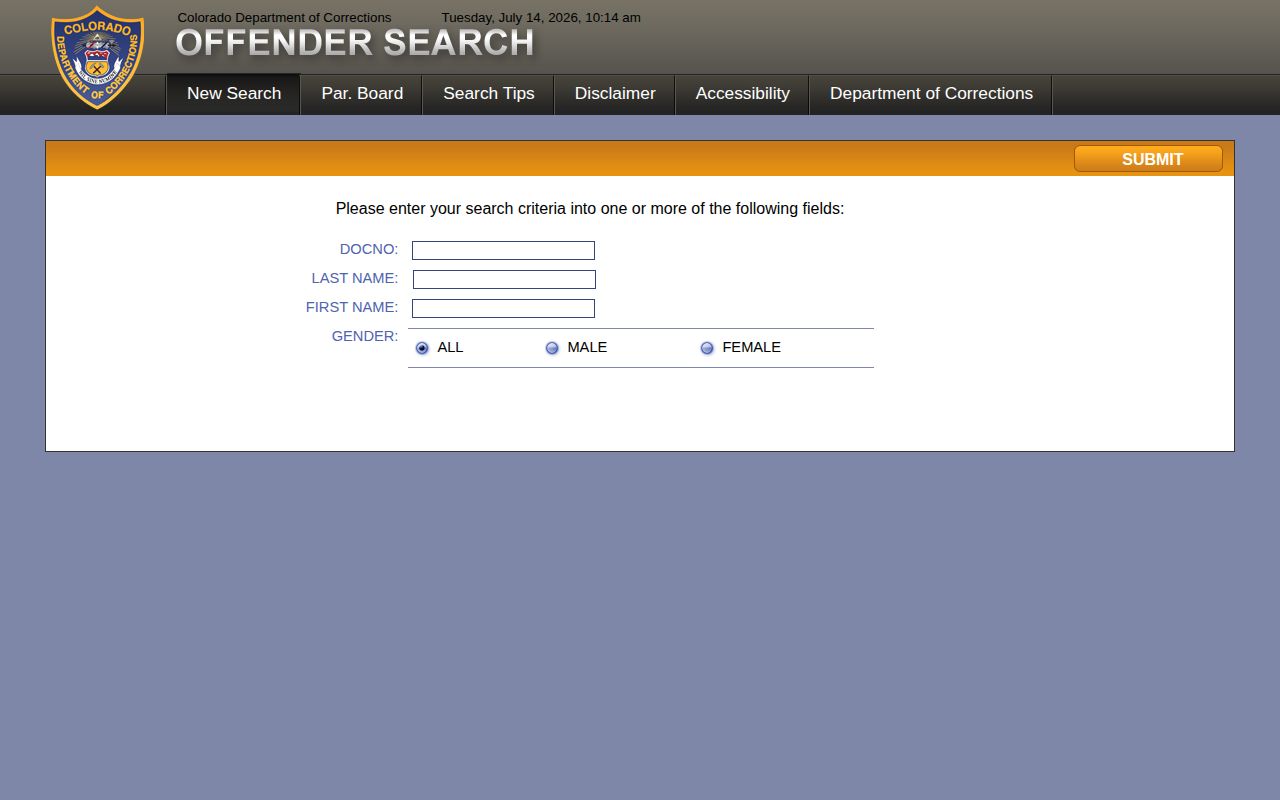
Use the exact field labels shown on the live CDOC result, because public screens can change.
Good-Time Credit and How Release Dates Are Computed
Colorado release-date math is not one universal percentage. For county jail sentences, the sentencing court determines the sentence and presentence confinement credit. C.R.S. 18-1.3-405 requires the court to make a presentence confinement credit finding and include it in the mittimus. C.R.S. 17-26-109 governs county jail deduction recordkeeping and requires records of inmate time deductions and changes caused by policy violations.
For CDOC sentences, Title 17 controls earned time, parole eligibility, mandatory release structures, and special categories. Listed violent offenses committed on or after January 1, 2025 can require 85 percent service before parole eligibility for listed offenses such as second degree murder, first degree assault, class 2 felony kidnapping, sexual assault, first degree arson, first degree burglary, or aggravated robbery. Older listed violent-offense categories can use different structures, and sex offenses, habitual categories, life sentences, and other special cases can differ. The correct calculation starts with the offense date, conviction offense, sentence, credits, and statute.
Why a Projected Release Date Changes
A projected date is only as stable as the records behind it. Garfield County users should compare the court record, jail record, CDOC record, and any hold or parole record before treating a date as final.
| Factor | How it can affect release |
|---|---|
| Court order or amended mittimus | Can change sentence length, credit, custody terms, or release authority. |
| Presentence credit correction | Can shorten or change remaining time if jail-credit findings are corrected. |
| Jail deductions or forfeitures | County jail deductions are tracked locally and can change after policy violations. |
| CDOC earned time or discipline | State calculations can change with earned-time awards, forfeitures, or recalculation. |
| Detainers, holds, or transfers | A person may leave Garfield County custody but move to DOC, federal, immigration, or another agency. |
| Parole Board action | Grant, denial, deferral, rescission, revocation, or release-plan issues can change when prison custody ends. |
Confirming a Release Date
For Garfield County Jail, confirm current custody or immediate release status with the jail at (970) 945-0453. For historical jail release proof, request the booking sheet or releasable release information from the Sheriff's Records Division. For a state-prison date, use CDOC Offender Search and CDOC records. For a pending custody change, register through the VINELink check process before release when possible.
For court-controlled reasons such as bond, sentence, time served, probation, dismissal, or warrant recall, search the Garfield County court docket or request the court record. The court record explains why custody changed; the jail record explains jail custody status; CDOC explains state prison or parole status.
Garfield Jail Date vs CDOC Date
Garfield's local roster quirk is the "Bond Amount or Release Date" column. It can show a future local release date for a current jail inmate, while the CDOC offender detail can show state fields such as parole eligibility or estimated mandatory release. Do not merge those into one date. A county jail release date answers when local jail custody may end. A CDOC date answers a state prison or parole calculation.
Rifle Correctional Center makes that distinction especially important in Garfield County. A person released from Rifle Correctional Center should be checked through CDOC and parole records. A person released from the Garfield County Detention Facility should be checked through the sheriff PDF, jail records, court docket, VINE, and any transfer system that applies.
Garfield Release Date Records
When dates conflict, compare the source records in order. The jail PDF is a snapshot and can lag because it updates automatically every two hours. The court sentence and mittimus control the sentence and presentence confinement credit. The sheriff's release or deduction record explains local jail time calculations. CDOC controls state-prison sentence fields, parole eligibility, parole hearing dates, and estimated mandatory release information. VINE can alert to a status change, but it does not explain the calculation.
For a local jail sentence, ask for the booking sheet, release information, and any releasable time-calculation detail from Garfield Sheriff's Records Division. For a DOC sentence, compare the Garfield court mittimus with the CDOC offender detail. For a parole question, use the parole-board calendar as a schedule source only, then confirm status through CDOC or the supervising authority.
Public Record Search
Sponsored Results